
If I stare hard enough everything will lose definition, like when repeating a word over and over whale whale whale I can hear myself moaning.
There was no moon. Just distant red lights of the windfarm defined our dark, scored the rhythm of our digging. We finished before dawn, enough of us to pack mud ten foot deep above the dorsal fin. Tide would ripple the grave invisible.
As the sea yellowed two more surfaced in the bay, less than a mile out, their bulk foaming the incoming tide. Our thudding couldn’t mask the wheeze of their sister compacting in the watery mud.
Wind brought in a spicy stink, like fresh sweat turning sour, scraping the back of our throats. It was cloying and thick, sticking to our lips, tongues. Our faces and clothes furred with its breath. Each swallow puttied with its syrup. When we didn’t eat, it singed our nostrils, sanded our teeth. Even our piss smelt rank. For the week everyone avoided the foreshore, and each other.
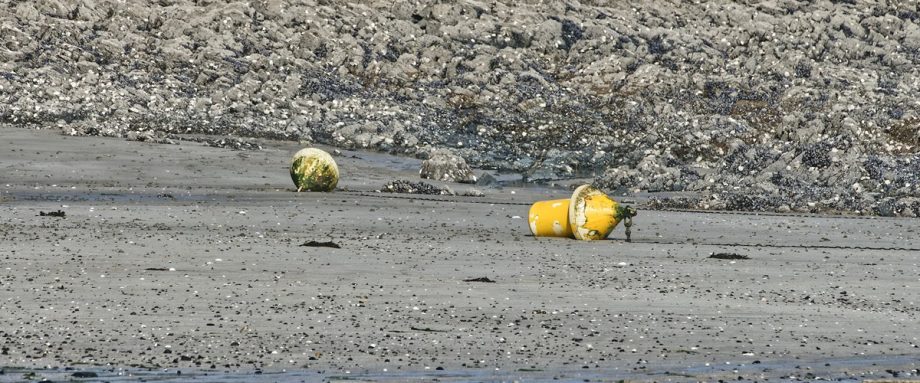
Me and my son are the first to walk the beach after that night. He’s desperate to get out, and we stalk the seawall, hunched like old men. Two channel buoys had beached on the skear and lie side-on, chained together. Starboard and port, both lights missing, pitched at the whim of the tide.
He runs across the beach to the red one. It dwarves him, and still he pushes against it, as if trying to heave it back to the water. He yells at me to come over, but I’m too cold. Hands in pockets, my body’s stiff like I’m one magnet resisting another. His face grows red from anger and exertion. I can’t tell what makes him more furious. Both me and buoys are dead weights in the wrong place.
He saw the whale first. I thought it was a jellyfish, twinkling on the mud, perhaps a mile off, but clearly visible from our upstairs window. He was eager to examine it, and I wanted to see him play. Within minutes he was back, sweaty as the foreshore, incoherent, inconsolable.
I took my spade and left him dry-sobbing on the seawall. Five metres away and it was bigger than I’d imagined, blacker than a mussel shell, oily. Light skimmed off its low dome, following my movements as I backed away.
It arrived the week before the cocklers’ Land Rover rose out of the mud, almost exactly ten years after they’d drowned. It had to be theirs, with sacks, full of cockles, piled in the back. I hadn’t gone with everyone else. I knew we wouldn’t be able to read anything in the sediment streaking the windscreen. That day I didn’t worry about anything else reappearing. All I could think of was the voice at the end of the phone crying out, ‘It’s dark and we are drowning.’
While my son is fighting with the starboard buoy, three dogs thrash the low tideline near where the grave is, digging in that frantic way dogs do, splattering shells and weed, clots of grit.
I throw a pebble. It falls well short. There’s no human with them. I hurl a larger rock, as hard as I can. It lands in the hole. Half their bodies disappear after it. I find another, and lob again, yelling. One of them yelps, but the other two continue to excavate, piling mud behind them, that could become the size of another whale.
Suddenly they all high-tail it, leaving the hole and the mud. My son runs to it. ‘Hey dad!’ he shouts and doesn’t wait for me to reply before jumping in. ‘Jonah!’ I scream. ‘What the—’
He stands up, waving a bony hand at me. It’s part of a skeleton fancy dress costume. White plastic bones on a black glove. A child’s hand. He offers it to me.
It fits, if tight and clammy. I clench my fist and brown liquid dribbles. It makes me invincible and for a second I scan the shore for the rest of the outfit before catching myself. He laughs and I raise my arm, splay my fingers. Wind attacks the wet material, making it colder still and me more aware of my hand than the rest of my body, as if I’m submerged and waving, waving to be hauled out.
I want him to remember the flat beauty of the bay, for him to look back on these days and think of the promontory, shored by gleaming tributaries, appearing as dauntless as the pressing together of palms.
‘Come on, kiddo.’ It’s getting cold and I reach for his shoulder, but he skewers away and runs to the one car in the car park. A black mammalian Buick, all waxed and expensive. There’s no sign of its driver. Ahead of me, Jonah tugs at a door handle.
I shout for him to stop but the door swings open and he scrambles in, slamming the door behind him. By the time I get to the car he’s in the driver’s seat, one hand by the ignition, feet dangling nowhere near the pedals.
A flock of something turns, swells and rushes overhead in a whirr of gushing water, gasping lungs, where one wrong step backwards and I’ll be drowning. The mist no rope to lunge for.
The car chokes and lurches forward before stalling. Jonah beeps the horn. The door he’d entered by is locked. I hammer on the window, kick metal and shout. He laughs and laughs inside the Buick’s belly.
Then he stills, turns and looks straight at me. His face contorts behind the glass. If I’d passed him in the street I wouldn’t have recognised him.
‘C’mon, Jonie,’ I wheedle, trying to smile calmly, aware the tide will be turning soon enough. And it’s springs. The water reaches the car park sometimes.
He doesn’t smile back. He doesn’t move, apart from shaking his head. ‘No,’ he mouths. ‘No.’
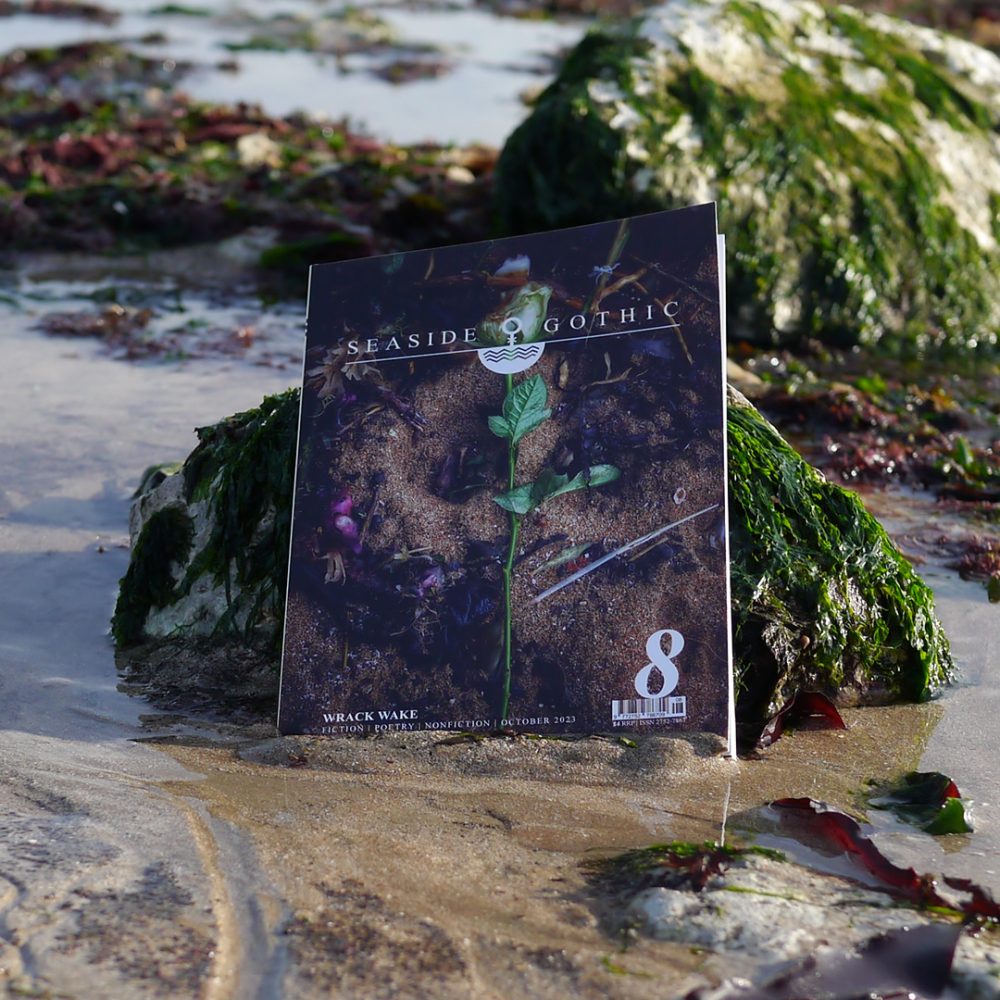
Issue 8
WRACK WAKE

Sarah Hymas lives by Morecambe Bay, England. Her writing appears in print, multimedia exhibits, as lyrics, installations, and on stage. She also makes artistbooks and immersive walks.