
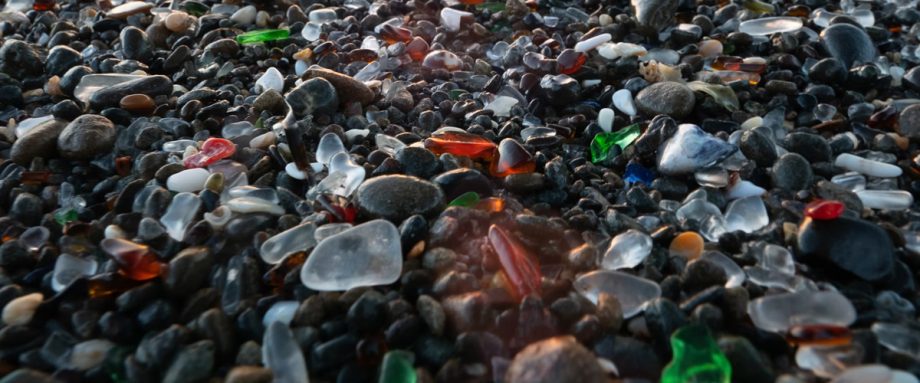
She’s on her knees when she first sees it glinting under the stove, bright green against the dull stone floor. The fires are out and the house is mercifully quiet. Her weary breath puffs like sea fog in the chill of the kitchen as she stoops lower to the ground. The pot feels cool enough to touch, but she knows the water inside is a trick, that if it tipped over on her she might scald her back and scream. The pain wouldn’t be the worst, but the punishment for waking her master would be. She reaches under and takes the sea glass in her hand, smooth and warm. Oughtn’t it to be cold, a thing like that?
She’s preparing luncheon when she sees the next piece, blue this time. She toes it under the stove to fetch later but it skitters recklessly across the floor. She holds her breath.
‘What was that noise?’
She rubs her knee, bent over, all show.
‘I’m sorry, Sir. I’ll be more careful.’
She lifts the lid and checks the stewing crabs. The pincers are closed, sharp but useless. Their eyes should be black but there’s one upturned, looking right at her and its eyes are blue. She glances at her master, then back to the pot. When she stirs it again, another crab surfaces. She takes a careful finger to its eye. Hard, and warm, as she knew it would be.
She is granted one day a month to do whatever she wants. Visit her family at the churchyard, or walk into town, anything to be free of the house, to be free of him. But today she stays in her room. The glass nests under her pillow, and it should be uncomfortable, but it’s not. For the first time in months, she sleeps well, and when she dreams, she dreams of fishing nets, scooping her up, tossing her in the foam. She wakes with her cheeks flushed and her heart pounding.
Over the coming days she finds more. An orange piece under the rug when she lifts it to dust (for her master’s daily checks are thorough). A yellow piece in the bathroom, bent over, clenching her nose at the stench of him. A pink piece jammed into the crack in the door frame from all the times he’s come home furious and seeking her out. She’s found more green than any other colour, and she wonders why. She wonders about bottles, like the ones he drains each night, tossed overboard and broken, the water crashing against the sharp edges, making all smooth. She wonders too about the nets in her dreams, wonders what else they might be trying to catch.
Other people start to join her in the dreams, in the nets. She wakes up grasping, as if she can untangle the rope, as if she can free them. Mostly they’re men, but they don’t pull at her the way her master does. Their eyes are stones, pale and smooth, but kind. Once there was a woman and a child, their skin bubbling, rippling under the water, and the mother smiled, only her teeth were small glass chips.
The pieces come to her room now. On the windowsill, under her bed, in the pockets of her torn skirts. She hides them in the trunk at the base of her bed, too many for the pillowcase now. She sometimes thinks she should be frightened, but she’s not. It’s a game. How many will I find today? How many before he notices?
She gets in less trouble. She’s happier. He thinks it’s because of him. He thinks he treats her well.
She’s outside pinning linens when she finds the bottle. Or, what was once a bottle. The outside is stuck with glass, dark and rich like her mother’s best brooch, before she had to pawn it. She lifts the bottle and rolls it in her hands. Inside, a crisp roll of paper. She tips it out and the note is dry. She lifts her hand to her eyes and looks over to the shoreline but she can’t see the sea from here, never could. There’s gulls dotting the sky but they’re small as fleas from this distance, and besides, they couldn’t grasp this bottle in their puny beaks. She looks down at the note and presses her fingers over the writing. Come.
She wakes, darkness all around. She slips into the shoes and shawl she’s hidden the evening before. The sea glass trails from the bed, to the door, the stairs, the garden. There, the moon shines on them, lights to show her way. She skips along, the house and the man ever further behind her. The harbour is empty of people and the small dayboats bob dizzily at their ropes, but the ship that has come for her is tall and sure.
It’s made of sea glass, thousands on thousands of small, coloured ovals. Even the ropes glisten. When they lower the anchor to her, she climbs on, her limbs slipping but her hands grasping and she sees that she was wrong in her dreams – these people don’t need her help, these people are already free. She reaches up to them and sees that their eyes are made of glass and their mouths too, every part of them. They call out to her, come. She lets the anchor raise her up. Come. She feels her skin, changing, shining, smooth and hard but still warm underneath, still warm. Come. When she boards they flock to her, their bodies on hers, chiming and clinking under the moonlight, and when she looks up at the sky the stars shine too. She looks back toward the land, the house, him, but she can no longer remember her old life, there is only the now, only the warm bodies on her and when looks up at their faces, all is blurred, all is green, like she’s looking through glass.

Issue 13
FOUND FOOTING

Gaynor Jones has won a Northern Writers Award and an Arts Council DYCP award for her work, and has been widely published in print and online. She is represented by Laura Williams at Greene & Heaton and is currently working on a folkloric seaside novel.