
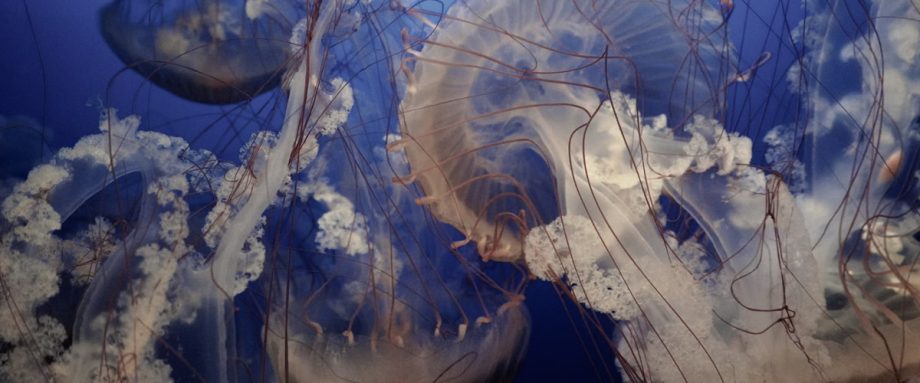
On the first day, there were seven of them along the waterline. Four small, pinkish jellyfish and three large ones, orange in the middle. They lay among the seaweed, crisp packets and plastic bottles. He toed one with his shoe and withdrew quickly. There was no resistance. He stepped over them and rooted carefully through the rest of the flotsam. The bottles were empty. He always hoped to find a message but never had.
He’d come to the seaside in September for a cheap holiday. It was a small Welsh town with one ice cream parlour, one chip shop, two pubs, and a Chinese takeaway. All the houses on the waterfront were pastel coloured and palm trees lined the promenade. He was the only guest in his B&B. There was a view of the beach from the top of the stairs on his floor. He’d chosen the cheapest room, and his window looked onto the bin area at the back. Gulls fought over the rubbish and screamed.
The beach was at the mouth of an estuary, and, when he stepped over the jellyfish and into the water, the force of the river was against the tide. He was pulled immediately downstream and staggered ashore, afraid of being dragged out to sea. He had promised himself he would swim each day. It was good for him. So he walked further down the beach and got in at a shallower spot. Here, the tide pushed him back inland, until he reached a point where the tide and the river met, and he was held in place by the competing force of salt and fresh water.
He stayed there for as long as he could bear it, then got out and had a strawberry ice cream, sitting on his towel on the sand. Further down the beach, a family flew a kite, and a man threw a ball for a dog. Dogs were allowed on beaches during the off season, and he liked watching them play with uninhibited joy.
After a night of gulls screaming, he swam at low tide, as the water came back in. He hoped the flood current would be less fierce than the ebb. In any case, he’d rather be pushed inland than out to sea. The beach was scattered with translucent globs of jellyfish, which shone and turned dull beneath racing clouds. There were, he counted, twenty-four of them. Flies danced over the bodies.
He swam for ten minutes against the current as the tide slowly pushed him upstream. It felt safer, heading inland, towards inhabited places. A jellyfish drifted past him like a large bubble beneath the surface. They were probably not dangerous. Wales seemed unlikely to have deadly animals. After giving in to the current and letting the waves take him to the end of the beach, he got out, and walked back to his towel.
This time, he treated himself to chips, crouching over them as gulls landed nearer and nearer, swooping low over his head, their yellow eyes meeting his. But for them, he was alone on the sand. He counted again as he walked back to the B&B. Twenty-nine jellyfish, he corrected himself. He supposed they came here on the warm currents and got lost. There were many bottles again, but no messages.
On the third day it rained. The sand looked sad and brown. He went to both of the pubs, but they were closed because there was a power cut in the town. So he sat in his room and scrolled on his phone until the battery died. Then he read a detective novel by the light of the window. He listened to the rain drum on the bins and the gulls fight over the scraps.
The sky cleared the following morning to blue with fast-moving clouds. He stepped over the jellyfish again, heaped in the seaweed. They covered the flotsam making it impossible to root through the plastic bottles, so he didn’t check for messages. He wondered if they washed ashore because they were dead already, or if they were dead because they’d washed ashore. The sea winked with opalescent gleams. This must have been sunlight on the surface, because up close, he couldn’t see any in the water. He put his clothes and shoes on his towel to stop it blowing away, walked down the beach, and got in. Slowly he drifted back towards his towel, its red corners fluttering. Then he felt a sudden shock as though a live wire had wrapped around his thigh. He shrieked, gulping water, but there was no one on the beach to hear him.
He staggered out, dragged on his clothes, and ran back to the B&B. The landlady was not there. He showered, watching the welts rise on his thigh, urinated down his leg, which he’d heard helped, and it stung more. Perhaps it was deadly. Did it even know he existed, that it had hurt him? Did anyone? He tried to call an ambulance, but the power was still out, his phone dead. He called for help as loudly as politeness permitted. From the window at the top of the stairs he saw them heaped on the beach.
The next morning, all the lights in the room were on and a radio blared downstairs. In the back yard, the bins lay on their sides, gaping. The gulls tore at a red, meaty heap on the ground. The welts on his thigh were swollen and sore. He hobbled to the corridor and looked out the window. Outside, the sea foamed. The sand gleamed as though covered in soap suds. Jellyfish were piled, sloppy, wet, on the shore, and clogged the estuary, neither moving upstream nor downstream, but seething and shimmering in a gelatinous mass. He went back into his room and plugged in his phone. There was a burnt plastic smell, the lights went out, and the radio stopped. He heard, faintly, from the back yard, a cry.
Help.

Issue 10
LOST SHOAL

Saskia McCracken is a Glasgow-based writer. Her pub-lications include Imperative Utopia (-algia press), Cyanotype (Dancing Girl Press), The King of Birds (Hickathrift Press), Common Name (Osmosis Press) and Zero Hours (Broken Sleep Books). She was shortlisted for the Bridport Flash Fiction Prize.