
I pass through a thicket and notice one tree standing out from the rest. A battle-scarred ancient oak, its misshapen trunk mottled with knots and burls, its roots rising and twisting like spiral steps in the ground, gnarled branches forming bridges and archways. I wonder how old it is, what stories its gnarls and scars would tell if they were able to speak.
The ground here on Portsmouth’s Milton Common is bumpy, riddled with troughs and dips, mounds and hollows. It’s a motley of terrains from soft grass to seaweed sludge, patches of sand-drifts to jagged rocks. Natural reedbeds surround the trio of tiny ponds, fen-like marsh. I swing round to meet the wide shoreline path, the peaty odour of rich soil fading, replaced by a waft of sea salt. I turn to face the sea, the horizon swelling into a panorama. On a cloudless day, its edges are black-inked lines on a map, boats—yachts and dinghies—gently bobbing up and down with the soft tide-flow. To my right leans the southernmost tilt of Eastney Point; to my left, the jut of the Farlington Marshes peninsula.
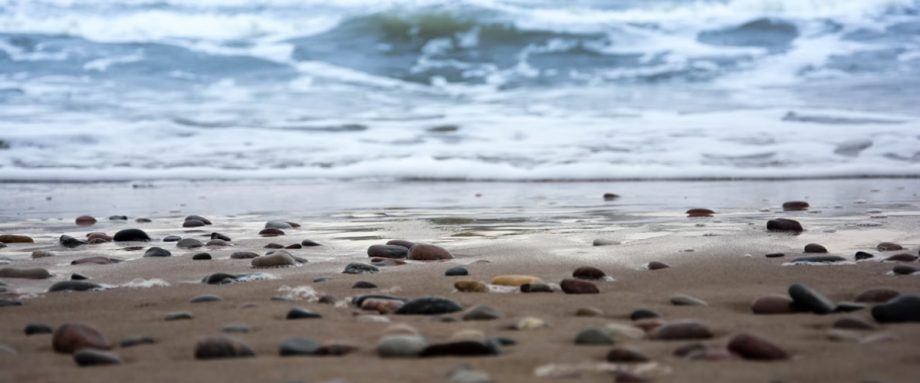
I sit on the stone defence wall, watching the gentle lap of the wavelets soaping foam and seaweed onto the narrow stretch of shingle. The incoming tide washes over it, licking the wall’s bastion, covering it in salt and seaweed slime. But here, you sense something of the sea’s mood: savage surge, calm ebb, the traces that linger long after the tide’s retreat. Sea glass, bubble-wrap bobbles of black weed, hag-stones and lichen. Strewn feathers and crab claws, tide-eroded pebbles and shell pieces. Driftwood and soapy foam. Broken glass and plastic.
I came here as we emerged from the first COVID-19 lockdown. My cat Mitzi had just died after a serious illness. She had just turned fourteen and I’d nurtured her, along with her litter-sister Mollie, from kittenhood. When it comes to animals, my maternal—although I prefer to think of it as my nurturing—instinct takes hold and doesn’t let go. Cats have been close companions in my life from when I was a baby right up until now, as I enter my Mabon years. The precarious, transient years of house-sharing during early adulthood, were the only times that I did not have a cat.
Several days afterwards, I’d been alone at home, hollowed but antsy, unfocused. Outside it was warm, the sky dappled with a fuzz of cotton-wool cloud. I left home and went out. I didn’t know where.
Numbly, I passed through the cemetery at the bottom of my street, over the railway-crossing Copnor Bridge. My legs were carrying me somewhere, subconsciously guided by a mind in fugue. Unseeing, I passed rows of Victorian terraces, larger, grander Edwardian houses until I reached the common, this green waveless sea I could lose myself in, the sea itself a few steps away. I walked across the common until there was no more land. I sat on a huddle of boulders for a long time looking out at the water.
Scanning the shoreline for pebbles. I chose a flat grey slab and spelled out her name in small stones, drawing a cat’s face next to it. Afterwards I wondered how long the tiny cairn remained there: whether the unsentimental tide would have swept the little pieces of her memento away, sending them spinning in all directions, like scattered ashes, dissolving into sea, sand or soil. Whether a passer-by might linger, before adding their own memorial. Later, back at home, I felt more grounded, smoothed, as if somebody took a sander and softened the sharp edges of my grief. Looking back, I realised that unconsciously, I was drawn to the sea that day.
There is something about edges and crossings and extreme landscapes or structures that we feel pulled towards in times of grief, as there exists a kind of grief cartography. It can be mapped: it is a psychological and metaphorical landscape, and it has its own trajectory and language. It defies, denies and distorts linear time for it exists in its own sphere, its own universe. For me, there is something interconnected about grief and the sea. Something tidal, for grief is tidelike—it ebbs and flows. Sometimes it is bittersweet, gentle ripples over bare toes—the initial cold sting fading to a near-fond nostalgia. With the passing of time, we learn to swim again; riding grief’s waves, surfing them, keeping the head above water, rolling over their steady rhythm in a kind of dance of acceptance.
But there are times when it catches me out, when its tidal force is unpredictable, knocking me off balance, pulling me down, into the sea’s colossal opaqueness. Where the turbid water is so boundless it feels oppressive. A slow drowning. The times when grief is a great tsunami crash; sending clouds of fizzing white foam which spit in my face, blinding me with white and salt, stinging my ears with the howl of a Fury. A maelstrom of sea-suck, spinning and swirling, frenzied, into a vortex. Into a black hole, the black hole that lives inside me. The one that I try and keep lidded at all times; for when it opens up, everything that is me and is important to me—all my loves and goals and values—are sucked into its void, and all that’s left is a cracked whelk-husk, flung far up onto the shingle bank.
The sea’s call is urgent, when caught in this emotional edgeland. In grief and times where emotions are either stretched out to their edge as if they might, at any moment, split me in two, or when they are so blurred that I don’t know how to describe how I’m feeling, or whether I’m feeling anything at all. The land’s edge is a crossing place that defines these emotions and lays them bare, offering a kind of strange relief or release, a way out or a way back. Or a way forwards.

Issue 12
SEA GATE

Rachel C. Birchley is a Portsmouth-based writer studying for a PhD in creative writing, working on a thesis which blends psychogeography, memoir, and nature writing. Rachel also writes poetry, short fiction and music reviews, which have been published in anthologies and online.